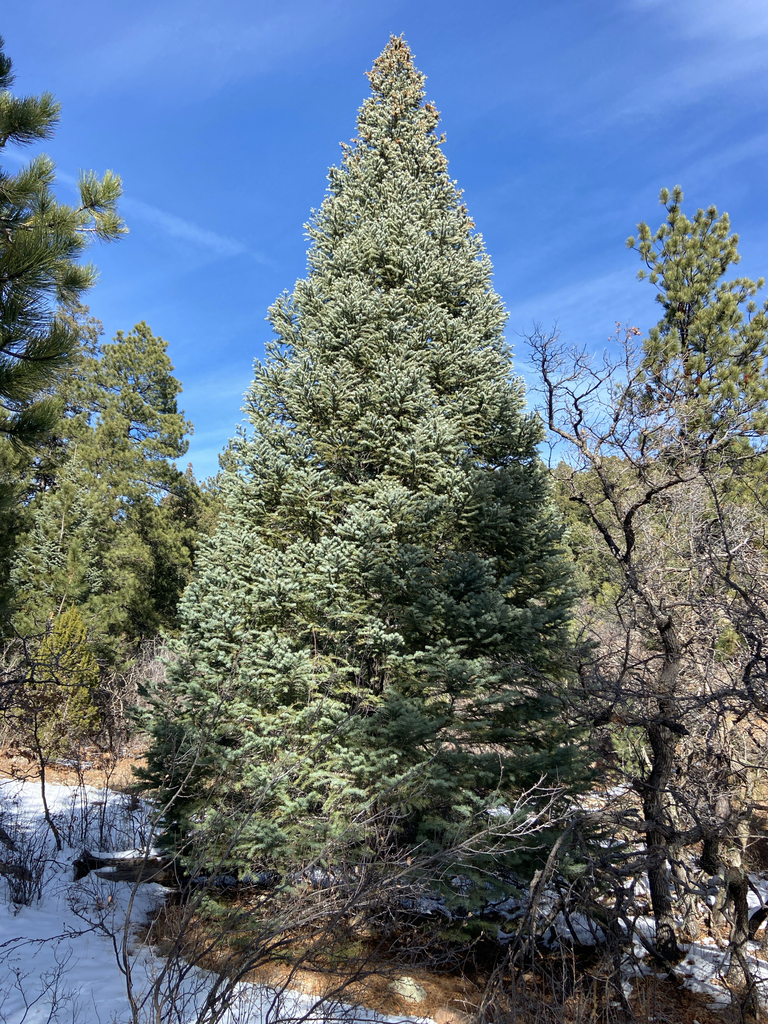
White / Concolor Fir

Abies concolor

Cultivars: 'Candicans', 'Compacta', 'Blue Cloak'

White fir, commonly referred to as concolor fir, is a large, elegant evergreen conifer valued in Rocky Mountain landscapes for its soft blue-green needles, symmetrical form, and strong adaptability to regional climates. It develops a tall pyramidal habit with layered branching that gives it a refined, stately presence in residential and commercial landscapes. The needles are long, flat, and soft to the touch, often displaying a silvery-blue cast that provides year-round color contrast against darker evergreens and winter snow. When used as a specimen tree, white fir creates a strong vertical focal point; in group plantings or windbreaks it offers screening, structure, and winter interest. Cultivars such as ‘Candicans’ and ‘Blue Cloak’ are selected for their particularly intense blue foliage, while ‘Compacta’ offers a more restrained growth habit suited for smaller properties or managed landscapes. 

In landscape use, white fir performs best when given space to develop its natural shape without excessive pruning. It has a moderate growth rate and will gradually form a broad, full crown with strong central leadership. This species is valued for its tolerance of Rocky Mountain conditions, including cold winters, alkaline soils, and moderate drought once established. It is commonly used in larger yards, parks, commercial plantings, and mountain-adapted residential landscapes where a long-lived evergreen is desired. Because of its eventual size, careful placement away from structures and overhead lines is recommended. Cultivar selection allows designers to choose between more compact forms or more intensely colored blue foliage depending on aesthetic goals.

Plant Characteristics
Plant Color
Blue-green to silvery blue evergreen foliage
Flower Color
Inconspicuous
Bloom Time
Fall Color
Evergreen
Height
30–50'
Width
15–25'
Water Use
Medium
Care Instructions

White fir prefers full sun and performs best in well-drained soils with moderate moisture. Once established, it exhibits moderate to low water needs, especially compared to many other fir species, though consistent irrigation during the first few years is important for root establishment. Deep watering during extended dry periods is beneficial, particularly in exposed or urban sites. This species generally does not require winter protection in the Rocky Mountain region, as it is well adapted to cold temperatures and snow loads. Pruning needs are minimal and should be limited to removal of dead or damaged branches or light shaping while the tree is young. Avoid heavy pruning, as it can disrupt the natural form. Mulching around the base helps retain soil moisture and regulate temperature, especially during establishment. Fertilization is rarely necessary in typical landscape soils unless a deficiency is observed.

White fir benefits from adequate spacing and airflow to reduce stress and maintain healthy growth. Young trees should be monitored for moisture during dry winters and watered periodically if soils become excessively dry. Staking is generally unnecessary except in very exposed planting sites. With proper placement and basic care, this species develops into a durable, low-maintenance evergreen that provides long-term structure and visual interest in Rocky Mountain landscapes.