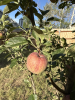
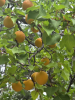
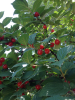
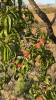
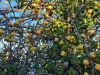
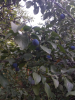
Delta County has grown fruit for more than a century, and the reason it works here is close to the reason it is difficult. This valley has the sun, the diurnal swing and the season for good fruit. It also has a late frost that turns up often enough to matter.
So the first question about a fruit tree here is not what you like to eat. It is when the tree blooms — because a bloom that opens before the last hard freeze is a crop you do not get, and that is a property of the species rather than of anything you did.
Roughly in order of bloom: apricot first, then peach, then sweet cherry, then plum, then pear, and apple last. Read that as a reliability ranking and it is nearly exact. Apricots are the heartbreak tree of this valley — they will give you a spectacular crop and then miss three years running. Apples bloom late enough to clear most frosts, which is not a coincidence and not unrelated to why this county is covered in apple orchards.
Here is what we stock and plant.
Most of them need a partner
The thing that catches first-time fruit growers is pollination. Most apples will not set a decent crop from their own pollen — they need a second, different apple variety blooming at the same time, within bee range. Sweet cherries are generally the same. Pears usually want a partner, and so do most Japanese plums.
Peaches, apricots, tart cherries and most European plums are self-fruitful and will crop on their own. Which means one peach tree is a reasonable plan and one apple tree usually is not — and that is the single most common reason somebody has a healthy, beautiful apple tree that has never produced anything.
Rootstock decides the size, and the wait
A fruit tree is two plants joined together: the variety on top, which decides what the fruit tastes like, and the rootstock underneath, which decides almost everything else. The same Honeycrisp is an eight-foot tree or a twenty-five-foot tree depending on what it is grafted onto.
- Dwarf — eight to ten feet, bears in two or three years, prunes and picks from the ground. Needs permanent staking; the root system does not hold a loaded tree up on its own.
- Semi-dwarf — twelve to eighteen feet, bears in three or four years. The usual right answer for a yard.
- Standard — twenty feet and up, five to eight years before it bears, and it will outlive you. A ladder tree.
Rootstock also affects how a tree handles the ground it is in, and on alkaline soil that is not a small detail — the wrong rootstock goes chlorotic here the same way an ornamental would. Worth asking about rather than buying on variety alone.
What a fruit tree actually asks of you
This is the part that gets skipped at the point of sale, and it is the difference between an orchard and a row of sad trees.
A fruit tree is pruned every year, in dormancy, for light and structure rather than for shape — an open center on peaches and plums, a central leader on apples and pears. An unpruned fruit tree gets dense, stops ripening fruit in the middle, and eventually breaks under its own crop. It is also thinned in early summer, which feels wrong and is not: a tree carrying too much fruit gives you small fruit, broken limbs, and nothing at all the following year.
And it is sprayed on a schedule. Codling moth is the reason for wormy apples and pears on the Western Slope, and controlling it means timed applications rather than spraying when you notice damage — by then the larva is inside the fruit. Peach leaf curl is prevented with a dormant application and cannot be fixed once leaves are out. Fire blight moves fast in apples and pears in a wet spring.
None of that is difficult. All of it is a calendar, and a calendar is the thing most homeowners do not keep. We plant fruit trees, we prune them, and we run spray programs on them — and if you would rather handle it yourself, ask us for the schedule and we will write it down.
We prune and spray them too
We plant fruit trees, we prune them, and we run spray programs on them, for homeowners with three trees and for properties with thirty.
Dormant pruning runs January through March, before bud break — a narrow window, and one of the few jobs in a yard that genuinely cannot be done late. The dormant spray goes on in the same stretch. After that the calendar is codling moth timing through the summer on apples and pears, and thinning in early June.
If you would rather do it yourself, ask and we will write out the schedule for the varieties you have. Knowing when is most of it.
Fruit as a landscape decision, rather than a harvest
If what you want is the look of fruit — color on the branch in October, berries against snow, birds in the yard — without the ladder and the spray calendar, that is a different decision and there are better plants for it. Fruit-bearing as a landscape characteristic covers what fruit does to a planting, including the part about never putting one over a patio.
Request an Estimate or call 970-835-9661