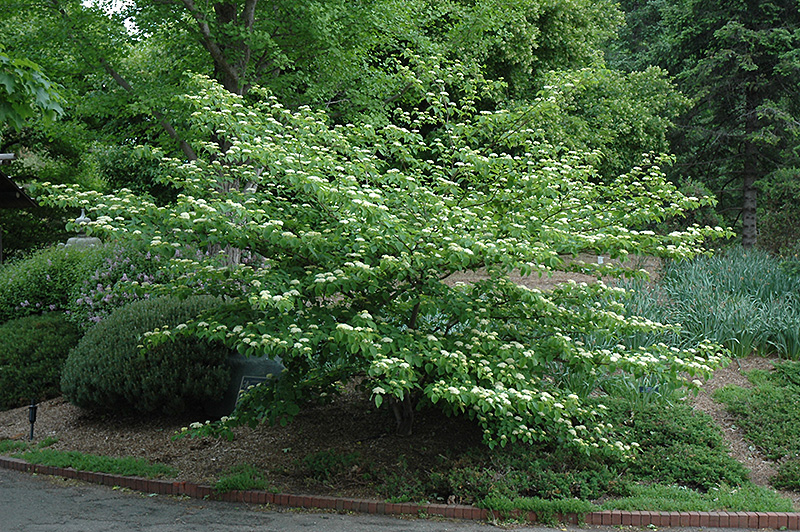
Dogwood shrubs are widely valued for their multi-season interest and adaptability in residential landscapes. Many types offer attractive spring flowers, rich green summer foliage, and strong fall color, followed by colorful winter stems in shades of red, orange, or yellow that stand out against snow. In the landscape they are often used in mixed shrub borders, along property lines, or in naturalized plantings where year-round structure and seasonal color are desired. Their branching habit ranges from upright and vase-shaped to broad and thicket-forming depending on species, making them versatile for both formal and informal designs.Upright, rounded shrubs with lush, green to variegated leaves and terminal clusters of small white flowers followed by bluish white fruit. The bright red, orange or yellow stems of some cultivars provide vivid winter color. Variegated cultivars boast bright green leaves leaves with creamy to white margins. The horizontal branching of Pagoda Dogwood (C. alternifolia) gives a layered effect and can be pruned into a small tree. Its small creamy white flower clusters produce bluish-black berries.
Dogwood
Cornus sericea, Cornus alba, Cornus mas, Cornus kousa
Cultivars: 'Ivory Halo', 'Midwinter Fire', 'Cherokee Brave'